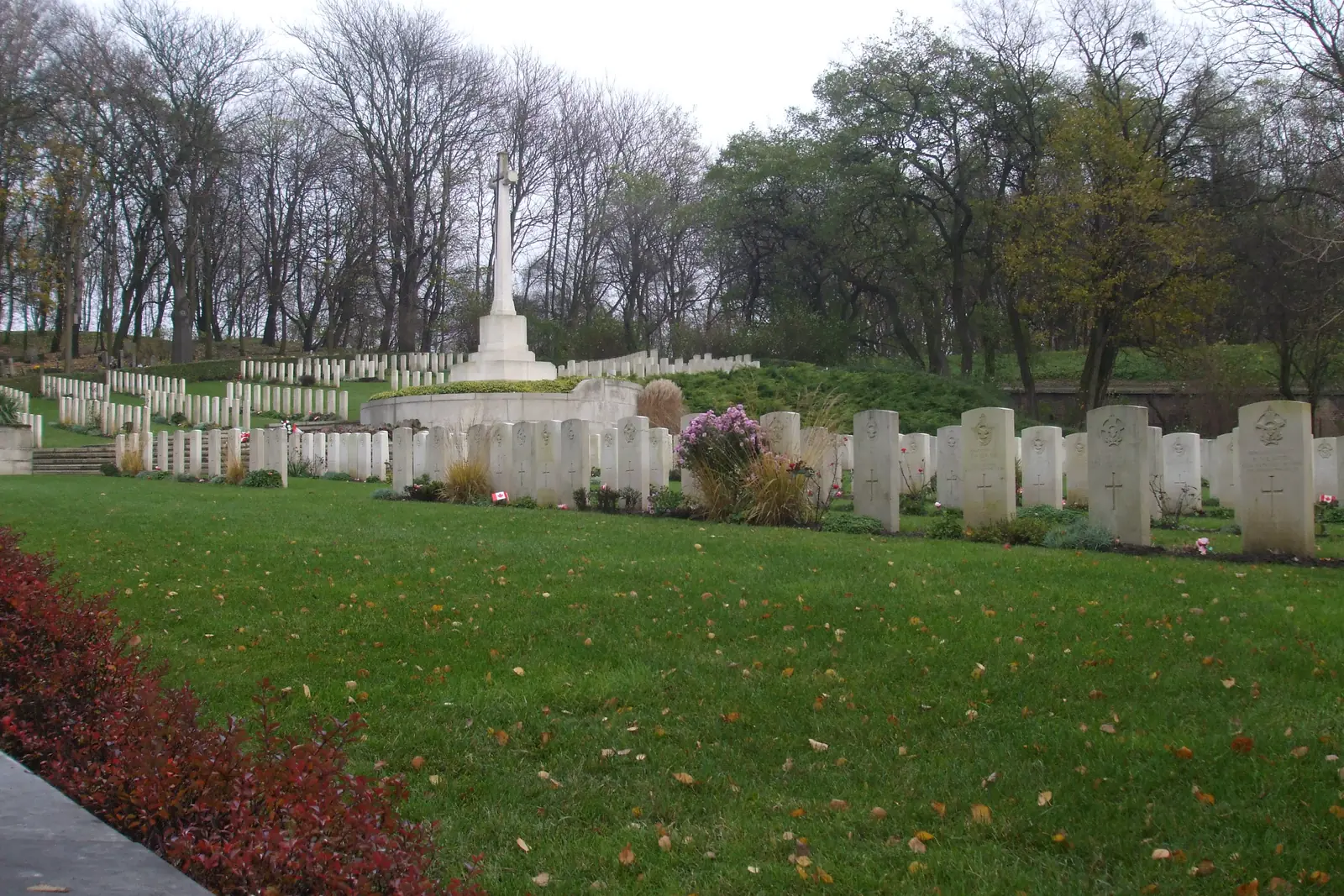
The cemeteries on the Citadel’s southern slope tell the history of Poznań in layers: prisoners of war held by Prussia, the insurgents of 1918, Commonwealth airmen, victims of the German occupation and the soldiers who died storming the fortress in 1945. They sit side by side, often separated only by a path. This guide explains which is which, how to find them and how to visit respectfully.
The cemeteries at a glance
The first three cemeteries below lie together near entrance G; the others follow westwards along al. Armii Poznań. Figures come from the city’s cemetery service and partly date from 2012.
| Cemetery | Who lies there | Size |
|---|---|---|
| Poznan Old Garrison (CWGC) | Commonwealth POWs and airmen, incl. the Great Escape | 427 people, 441 headstones (Polish register) |
| Orthodox Garrison | Orthodox soldiers and civilians, Danish POWs of 1864 | 74 people |
| Polish Heroes | Poznań fighters of 1945, victims of terror, June 1956 | 502 people plus ashes of thousands |
| Soviet soldiers’ | Red Army soldiers, mostly 1945 | 3,678 people (city data) |
| Polish Garrison | Polish soldiers 1918–1939, families, 1863 veterans | 1,521 people, 2.5 ha |
| St Adalbert Parish | civilian parishioners | 425 people |
The Commonwealth, Orthodox and Polish Heroes cemeteries are clustered near entrance G and the Poznań Army Museum; the Soviet cemetery surrounds the main steps; further west, the Garrison Cemetery lies in two sections either side of the parish cemetery. Our map of the Citadel (in Polish) shows them.
"Old Garrison" or "Garrison"? Avoiding the name trap
The Commonwealth cemetery’s official Polish name is "Cmentarz Wojenny Wspólnoty Brytyjskiej" (British Commonwealth War Cemetery), and some English guidebooks call it the British Military Cemetery.
Poznan Old Garrison Cemetery (Commonwealth)
The oldest CWGC cemetery in Poland was founded in 1925 for British prisoners of the First World War and enlarged after 1945. The CWGC lists 448 identified casualties, mostly Second World War airmen and prisoners of war, and the ashes of 48 of the 50 airmen murdered after the Great Escape, among them Roger Bushell. It is permanently open. Everything you need for a visit, including how to find a name, is on our page about the Great Escape graves in Poznań.
Polish Garrison Cemetery (Cmentarz Garnizonowy)
This is the largest of the cemeteries by area (2.5 ha), with about 1,500 graves in nine quarters on the western part of the slope. Its oldest military quarters date from the birth of independent Poland: quarters VII–IX form the Cemetery of the Greater Poland Insurgents and Those Fallen in 1918–1920, with more than a hundred identical crosses. Other quarters hold soldiers of the Polish–Bolshevik War, airmen of the 3rd Aviation Regiment from Ławica, veterans of the January Rising of 1863–64, generals and officers of the inter-war garrison and their families.
The cemetery was badly damaged during the Soviet assault of February 1945, and careless post-war clearance meant that the identities of many inter-war soldiers were lost for good.
Cemetery of Polish Heroes (Cmentarz Bohaterów Polskich)
Founded in the autumn of 1945, this cemetery lies between the Commonwealth and Soviet cemeteries on three terraces below a monument by Ryszard Skupin (1967). It holds:
- the Cytadelowcy, Poznań men who took part in the assault on the Citadel in February 1945 (middle terrace);
- mass and symbolic graves of victims of the German occupation, with inscriptions naming places of execution such as Fort VII, the Żabikowo camp and the Gestapo headquarters;
- Polish airmen and soldiers killed in September 1939;
- victims of the Poznań uprising of June 1956 (upper terrace) and of the Stalinist security police.
It is often confused with the burial place of the 1918 insurgents, who in fact lie in the Garrison Cemetery. More on our Polish page about the Cemetery of Polish Heroes.
Soviet soldiers’ cemetery and the Heroes’ Monument
The centre of the slope, on either side of the main steps, is the Soviet soldiers’ cemetery (Cmentarz Żołnierzy Radzieckich), the burial ground of Red Army soldiers, many of whom died in the Battle of Poznań in 1945 (in Polish). The city lists 3,678 people in 464 graves (data from 2012); Polish Wikipedia gives 5,829. Above it stands the 23 m obelisk of the Heroes’ Monument, unveiled in November 1945 (some sources say February 1946), with four 152 mm howitzers flanking the steps. The illuminated red star on its top was taken down in 1990 (some sources say 1989); since 1997 a bronze star has hung halfway up the obelisk.
The old name "Cemetery of Soviet Heroes" is now contested, and the city uses "Red Army War Cemetery" or "Soviet Soldiers’ Cemetery". Whatever one thinks of the monument, the graves themselves are war graves protected by law. See our Polish page on the Soviet soldiers’ cemetery.
The Orthodox cemetery and older relics
- Orthodox Garrison Cemetery (Prawosławny Cmentarz Garnizonowy): a small cemetery that probably dates from the 1920s, when an Orthodox garrison parish was founded. It took in a quarter of Danish prisoners of the 1864 war who died in Poznań military hospitals, and later Orthodox soldiers and settlers, "White" Russian émigrés, Ukrainians and Georgians. Most headstones were destroyed in 1945.
- St Adalbert Parish Cemetery (Cmentarz parafii św. Wojciecha): the second oldest cemetery in Poznań, granted to the parish in 1833 in exchange for land taken for the fortress. On 3 March 1846 Polish conspirators gathered here to wait for weapons for a planned attack on the Citadel.
- Prussian and German relics: the Soviet quarters occupy the site of the Prussian old garrison cemetery and a German First World War cemetery (Ehrenfriedhof). A mausoleum to Russian prisoners of the First World War and an obelisk to French prisoners who died in Prussian captivity still stand among them.
Note that the Cemetery of Distinguished Greater Poland Citizens is not at the Citadel but on St Adalbert’s Hill, which you pass on the walk from the Old Town.
Visiting the war cemeteries respectfully
These rules are our own advice based on common practice; we found no separate published regulations for the Citadel cemeteries.
- Keep to the paths and do not step on graves, sit on headstones or lean on walls.
- Keep voices low; picnics, ball games and music belong on the park lawns, not in the cemeteries.
- Wheel bicycles and scooters through the cemeteries, and keep dogs on a short lead.
- Photograph discreetly and never during a funeral or ceremony without permission.
- Before flying a drone anywhere in the park, check the airspace restrictions in the DroneTower app of the Polish air navigation agency (PAŻP); in our view, drones should not be flown over the cemeteries at all.
- Lighting candles (znicze) on graves is a Polish custom, especially around 1 November; keep tributes on Commonwealth graves small and take wrapping away.
Getting there is easiest via entrance G for the Commonwealth cemetery or entrance A for the main steps; see our getting there page.
Days of remembrance
| Date | Occasion |
|---|---|
| 23 February | End of the Battle of Poznań (1945); city ceremonies in the park (in 2025 at the Bell of Peace, with flowers at the monuments) |
| March | Anniversary of the Great Escape; service at the Commonwealth cemetery |
| 28 June | Poznań June 1956; tributes at the Cemetery of Polish Heroes |
| 1 November | All Saints’ Day; candles on graves across the slope |
For background on the fortress and the battle, read our history of the Citadel; the museums next to the cemeteries cover the 1939 campaign and the 1945 fighting.
Read more
- CemeteriesGreat Escape gravesThe ashes of 48 of the 50 airmen murdered after the Great Escape lie in Poznan Old Garrison Cemetery (CWGC): Roger Bushell’s grave, finding a name, visiting.
- HistoryHistoryFort Winiary history in brief: the Prussian citadel built 1828–1842, the 1918 uprising, the Second World War, the 1945 Battle of Poznań and the park since 1963.
- PracticalGetting thereGetting to Poznań Citadel: a 20-minute walk from the Old Market Square, trams to Armii Poznań, trains to Poznań Garbary, airport bus 159, parking and concert days.
Frequently asked questions
How many cemeteries are there at Poznań Citadel?
Eight burial places in all: the Commonwealth, Polish Garrison, Polish Heroes, Soviet soldiers’ and Orthodox cemeteries, the old St Adalbert parish cemetery, and relics of a Prussian garrison cemetery and a German First World War cemetery. Some sources count seven, because they treat the relics differently.
Is the Old Garrison Cemetery the same as the Garrison Cemetery?
No. "Poznan Old Garrison Cemetery" is the CWGC name of the Commonwealth war cemetery at the eastern end of the slope, near entrance G. The Polish "Cmentarz Garnizonowy" (Garrison Cemetery) is a separate Polish military cemetery further west.
Where are the Greater Poland insurgents of 1918–1919 buried?
In quarters VII–IX of the Polish Garrison Cemetery, known together as the Cemetery of the Greater Poland Insurgents and Those Fallen in 1918–1920, not in the Cemetery of Polish Heroes.
How many Soviet soldiers are buried at the Citadel?
City records list 3,678 people in 464 graves (data from 2012); Polish Wikipedia gives 5,829. Many died in the Battle of Poznań in 1945.
Are the Citadel cemeteries open at night?
The CWGC states its cemetery is permanently open. The other cemeteries lie inside an open public park, and we found no published opening hours for them.
Is the Cemetery of Distinguished Greater Poland Citizens at the Citadel?
No. It is on St Adalbert’s Hill by St Joseph’s Church, south of the Citadel. You pass close to it on the walk from the Old Market Square.
Can I take photographs in the cemeteries?
Private photography is generally fine if you are discreet. Avoid photographing mourners or ceremonies without permission; for commercial shoots ask the city’s green spaces authority (ZZM) first.
Sources and verification
Facts on this page were checked against the sources below on 13 November 2026. Opening hours and prices can change — confirm with the venue before your visit.
- Poznań City Hall — Cmentarze na Cytadeli (cemetery series)
- Poznań City Hall — Cmentarz Wojenny Wspólnoty Brytyjskiej
- Poznań City Hall — Cmentarz Garnizonowy
- Poznań City Hall — Cmentarz Bohaterów Polskich
- Poznań City Hall — Cmentarz Bohaterów Radzieckich
- Poznań City Hall — Prawosławny Cmentarz Garnizonowy
- CWGC — Poznan Old Garrison Cemetery
- Wikipedia (PL) — Park Cytadela
- Wikipedia (PL) — Cmentarz parafii św. Wojciecha w Poznaniu