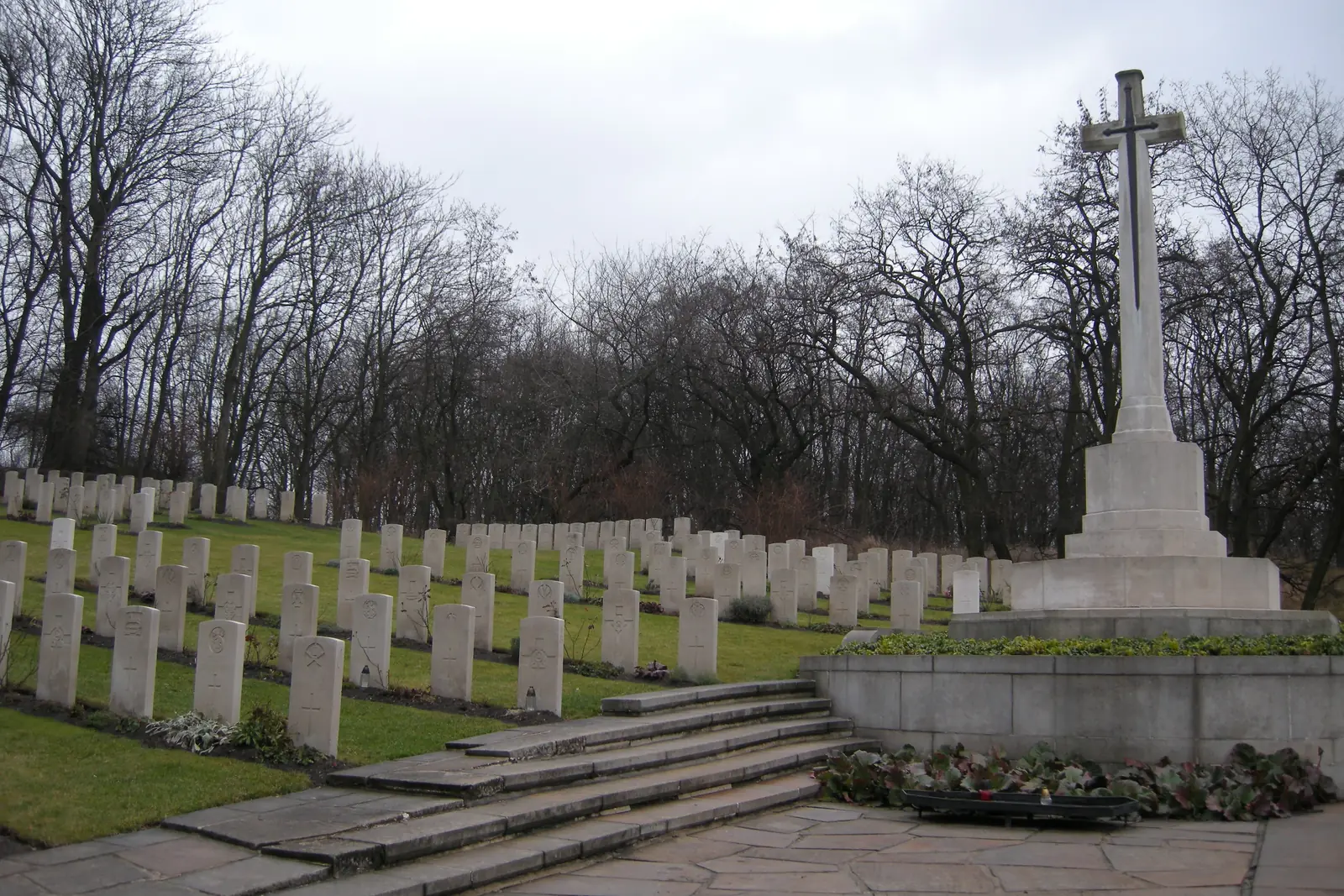
Many people are surprised to learn that the airmen murdered after the Great Escape lie not near the camp in Żagań but in Poznań, about 200 km away. Their resting place, Poznan Old Garrison Cemetery, is a small, well-kept Commonwealth War Graves Commission (CWGC) cemetery set into the wooded southern slope of the Citadel. This page explains how to find it, who is buried there and how to locate an individual grave.
Where the graves are and how to reach them
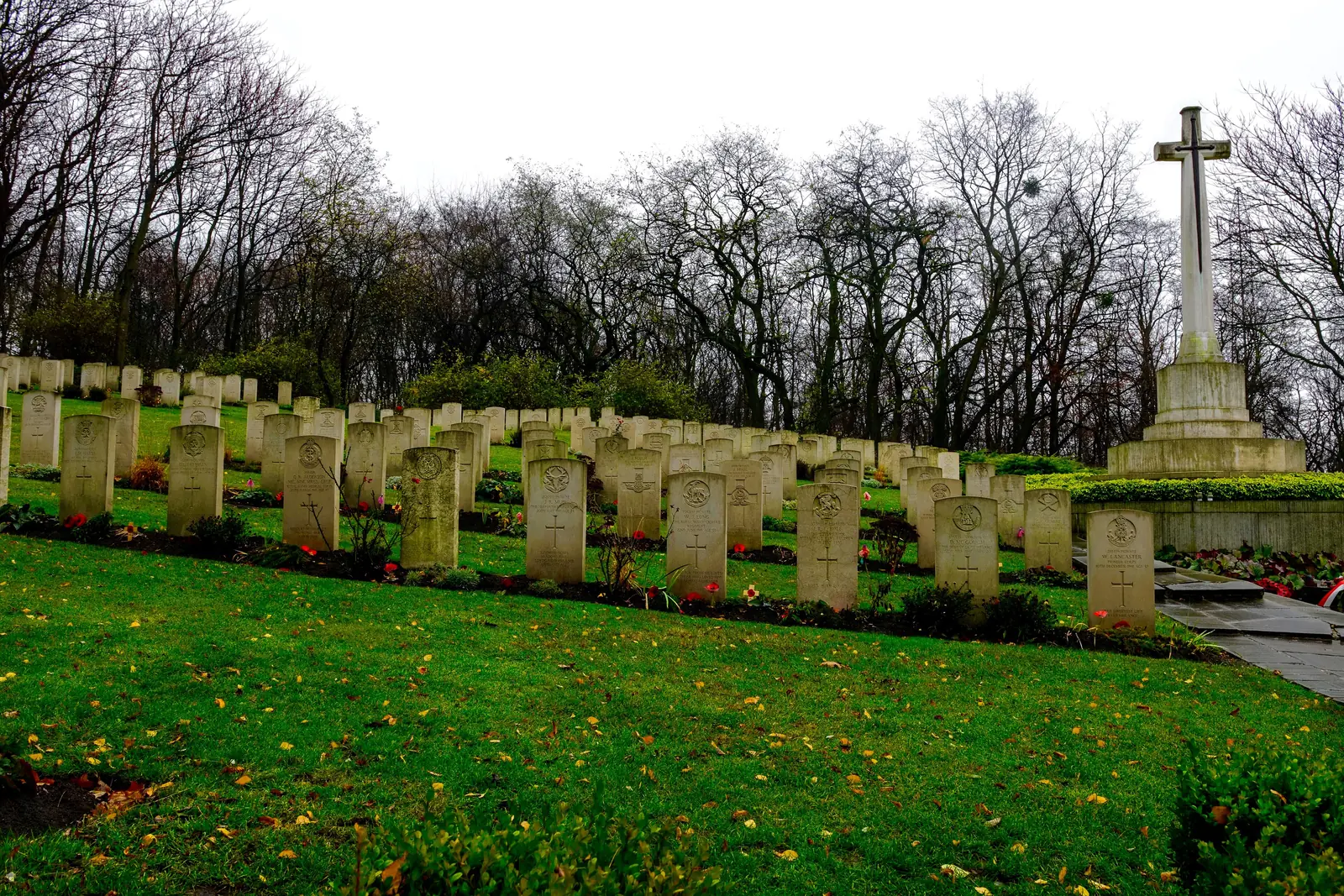
The cemetery is inside Citadel Park, beside al. Armii Poznań. The closest way in is entrance G, on al. Armii Poznań by ul. Ku Cytadeli; the main entrance A, at the foot of the monumental steps leading up to the Heroes’ Monument, is about 120 m west of the cemetery. The cemetery lies at the bottom of the slope, below the terraces of the Cemetery of Polish Heroes (in Polish) and just west of the Poznań Army Museum (Muzeum Armii „Poznań”); look for the CWGC sign and the stone Cross of Sacrifice between its terraces. Our map of the Citadel (in Polish) marks the entrances.
- From the Old Market Square: about 1.4 km on foot, around 20 minutes.
- From Poznań Główny: one stop by regional train to Poznań Garbary, then about 300 m on foot.
- By car: the CWGC directs drivers from ul. Garbary into al. Armii Poznań at a CWGC sign; the cemetery is about 700 m further on, on the right. Parking nearby is very limited.
Full directions, including from the airport, are on our getting there page. The cemetery is permanently open and free. There are no facilities inside; the nearest public toilet (daily, about 10:00–18:00) is near the Museum of Armaments, uphill.
The Great Escape and the murder of the Fifty
On the night of 24–25 March 1944, 76 Allied airmen crawled out of Stalag Luft III at Sagan (now Żagań) through a tunnel known as "Harry"; a 77th was spotted at the exit. All but three were recaptured. Hitler wanted every escaper shot; after objections the number was fixed at fifty, and the Gestapo murdered them in small groups after recapture.
The bodies were cremated and the urns sent back to the camp. The prisoners, with the permission of a new commandant shocked by the killings, built a memorial with a vault for the ashes. When an RAF search team arrived in 1948 they found the memorial damaged and many urns broken. The CWGC states that the ashes of all but two of the fifty were then buried in Poznan Old Garrison Cemetery.
Who lies here: the Fifty and their nationalities
The fifty murdered airmen came from across the Allied air forces. One common breakdown is:
| Nationality | Men |
|---|---|
| British | 21 (including one born in Argentina) |
| Canadian | 6 |
| Polish | 6 |
| Australian | 5 |
| South African | 3 |
| New Zealand | 2 |
| Norwegian | 2 |
| Belgian, Czechoslovak, French, Greek, Lithuanian | 1 each |
Some lists count the Argentine-born John Stower separately, giving twenty British. The six Poles are Jerzy Mondschein, Antoni Kiewnarski, Paweł Tobolski, Stanisław Król, Włodzimierz Kolanowski and Kazimierz Pawluk. Others buried here include the Greek pilot Sotirios Skantzikas, whose epitaph is in Greek, the Canadian navigator Gordon Kidder and the Lithuanian Romualdas Marcinkus.
Roger Bushell’s grave
Squadron Leader Roger Joyce Bushell, the South African-born airman who led the escape organisation as "Big X", lies in collective grave 9. A. (CWGC reference). A pre-war member of No. 601 Squadron, Auxiliary Air Force (the unit named in his CWGC record), he was commanding No. 92 Squadron when he was shot down near Calais on 23 May 1940. After the breakout he was recaptured at Saarbrücken. He was murdered on 29 March 1944, aged 33. His epitaph opens with the words "A leader of men".
The Great Escapers do not all lie in one row: the Polish register places them in different plots (including plots 8 and 9), some in shared graves, so look up each name before you go.
How to find a particular grave
- Open CWGC Find War Dead, search by surname and filter the cemetery to "Poznan Old Garrison Cemetery".
- Note the grave reference: plot, row and grave, or "Coll. grave" for a shared grave.
- Download the cemetery plan from the CWGC cemetery page, or use the free CWGC For Evermore app (iOS and Android), which offers tours of the cemetery and can scan a headstone to show the casualty’s details.
- For a Polish-language source, the Wielkopolska Voivode’s published list gives every burial with its plot, row and grave, the full inscription and a translation.
The wider cemetery: First and Second World War graves
The cemetery was founded in 1925 on a section of the old Prussian garrison cemetery, for First World War prisoners of war brought here from camp cemeteries across Poland. It is the oldest CWGC cemetery in Poland. During the assault on the Citadel in February 1945 (in Polish) the Cross of Sacrifice and many headstones were damaged or destroyed; the cemetery was restored in the 1950s and again in 2004. The upper part holds mainly First World War graves, the lower part only Second World War ones.
According to the CWGC, the First World War section commemorates 174 men, including special memorials to 48 prisoners known to be buried in camp cemeteries at Czersk, Szczypiorno and Piła (Schneidemühl) whose graves were lost. The 283 Second World War burials are mostly airmen, many killed in raids on Stettin (Szczecin), together with prisoners from camps such as Stalag VIIIC at Sagan and Stalag XXID at Posen. A separate Poznan Memorial names five men of the Royal Naval Air Service armoured car unit killed in 1917 near Brzeżany (now Berezhany, Ukraine). The CWGC lists people from fifteen countries here, from Australia and Jamaica to Newfoundland and the United States.
How many are buried here? Why the numbers differ
| Source | Figure |
|---|---|
| CWGC cemetery page | 448 identified casualties |
| CWGC history page | 478 buried or commemorated, 25 unidentified |
| CWGC schools resource | 473 war graves |
| Polish war graves register (2022) | 427 people, 441 headstones |
The figures count different things: identified casualties only, everyone buried or commemorated (including special memorials), or individuals and physical headstones in the Polish register. Note too that the 48 First World War special memorials have nothing to do with the 48 Great Escapers; the match is coincidence.
Commemorations in March and Remembrance in November
The main ceremony at the cemetery is held in March, around the anniversary of the breakout on the night of 24–25 March 1944. It follows a set form: ecumenical prayers, a Polish military roll call of remembrance (Apel Pamięci) and the laying of flowers.
| Year | Date | Organised by |
|---|---|---|
| 2024 (80th anniversary) | Saturday 23 March | British Consulate in Poznań |
| 2025 (81st) | Sunday 23 March | British Embassy and the Poznań garrison commander |
| 2026 (82nd) | "March 2026 (date and time to be confirmed)" | British Embassy; we found no report of the ceremony |
| 2027 (83rd) | expected in March | not yet announced (as of 13 November 2026) |
In 2027, 24 and 25 March fall on a Wednesday and a Thursday. If the weekend pattern of 2024–2025 continues, the service may be held around 20–21 March, but that is our inference, not an announcement. Watch GOV.UK for the details.
November is different. The embassy’s Remembrance services in Poland in 2024 (Lidzbark Warmiński, Malbork, Kraków and Warsaw) and in 2026 (the same towns plus Popielów, all at 10:40) did not include Poznań, and its 2025/26 schedule listed Poznań only for March. Remembrance here is now a matter of local and private gestures: on 1 November 2025 the Wielkopolskie Muzeum Niepodległości laid wreaths on the graves of the Polish crew of Halifax JD154 of No. 138 (Special Duties) Squadron RAF. If you wish to lay a poppy cross in November, you can do so on any day.
Attending a ceremony
The cemetery is permanently open, so members of the public can come to the March service, but the ceremony is organised for official delegations. Our suggestions:
- Stand back, behind the official party, and do not walk between the rows of graves while the ceremony is under way.
- Keep silent during the prayers, the roll call and the laying of flowers, and switch your phone to silent.
- Do not photograph delegations or families at close range; if you take pictures, do so discreetly and from a distance.
- Lay your own flowers or poppy cross after the official part has ended.
Visiting respectfully
This is a war cemetery inside a busy park. Keep to the paths, speak quietly, do not sit on headstones or walls, and photograph discreetly, especially if a family or a ceremony is present. If you bring a tribute such as a poppy cross or flowers, place it by the headstone and take any wrapping away with you. Our guide to all the war cemeteries covers etiquette on the neighbouring Polish and Soviet cemeteries.
Nearby, the Poznań Army Museum occupies the casemate next to the cemetery, our history page tells the story of the fortress, and the visitor guide suggests how to spend the rest of your time at the Citadel.
Related trip: Żagań and Stalag Luft III
The site of Stalag Luft III lies in Żagań, about 200 km south-west of Poznań by road, roughly two and a half hours’ drive. The Muzeum Obozów Jenieckich (POW Camps Museum) there includes a reconstruction of Hut 104, from which tunnel "Harry" was dug. Since the end of June 2026 the museum’s main building has been closed for renovation until further notice, while the exhibitions in the hut replica remain open. The museum marked the 82nd anniversary of the escape on 21 March 2026. Check its website before you travel.
Frequently asked questions
Where are the Great Escape airmen buried?
The ashes of 48 of the 50 men murdered after the escape from Stalag Luft III are buried in Poznan Old Garrison Cemetery, a CWGC cemetery in Citadel Park, Poznań, western Poland.
Is Roger Bushell buried in Poznań?
Yes. Squadron Leader Roger Joyce Bushell, "Big X" of the escape, lies in collective grave 9. A. of Poznan Old Garrison Cemetery, according to the CWGC record.
Why are only 48 of the 50 in Poznań?
According to the CWGC, in 1948 the ashes of Flight Lieutenant Denys Street were buried in Berlin 1939–1945 War Cemetery, and those of the Norwegian Pilot Officer Nils Fuglesang were returned to his home on the island of Hidra, near Flekkefjord.
What are the opening hours of Poznan Old Garrison Cemetery?
The CWGC describes the cemetery as permanently open to the public. There is no admission charge.
How do I get to the Commonwealth cemetery in Poznań?
Walk 20 minutes north from the Old Market Square, or take a train one stop from Poznań Główny to Poznań Garbary, about 300 m away. Enter the park at entrance G on al. Armii Poznań, by ul. Ku Cytadeli.
Is there a Great Escape memorial service in Poznań?
Yes, in March, around the anniversary of the escape: on Saturday 23 March 2024 (80th anniversary, organised by the British Consulate in Poznań) and on Sunday 23 March 2025 (British Embassy and the Poznań garrison commander). For 2026 the embassy listed only "March, date and time to be confirmed". Check GOV.UK before you travel.
Is there a Remembrance Sunday service at the Poznań cemetery?
Not in recent years: the British Embassy’s November Remembrance schedules for Poland in 2024 and 2026 did not include Poznań. You are welcome to lay a poppy privately at any time.
How far is Żagań from Poznań?
About 200 km by road, roughly two and a half hours by car. The POW Camps Museum in Żagań stands on the site of Stalag Luft III.
Sources and verification
Facts on this page were checked against the sources below on 13 November 2026. Opening hours and prices can change — confirm with the venue before your visit.
- CWGC — Poznan Old Garrison Cemetery (cemetery details)
- CWGC — Poznan and the Great Escape: the Great Escape
- CWGC — Poznan and the Great Escape: history of Poznan
- CWGC — Flight Lieutenant Denys Oliver Street
- CWGC — Pilot Officer Nils Jørgen Fuglesang
- Wikipedia — Roger Bushell
- CWGC — Find War Dead
- Wielkopolska Voivode — list of those buried in the Commonwealth war cemetery (2022, PDF in Polish)
- Wielkopolska Voivode — war cemetery record card (2022, PDF in Polish)
- GOV.UK — Remembrance in Poland: UK and Commonwealth services 2025/2026
- GOV.UK (3 Sep 2024) — Remembrance in Poland: UK and Commonwealth services
- GOV.UK (6 Oct 2026) — Remembrance in Poland: UK and Commonwealth services 2026
- Wielkopolska Voivode — calendar of state and veterans’ ceremonies 2024 (PDF in Polish)
- Wielkopolska Voivode — calendar of state and veterans’ ceremonies 2025 (PDF in Polish)
- Wielkopolskie Muzeum Niepodległości — airmen commemorated at the cemetery on 1 November (in Polish)
- Muzeum Obozów Jenieckich w Żaganiu (POW Camps Museum)