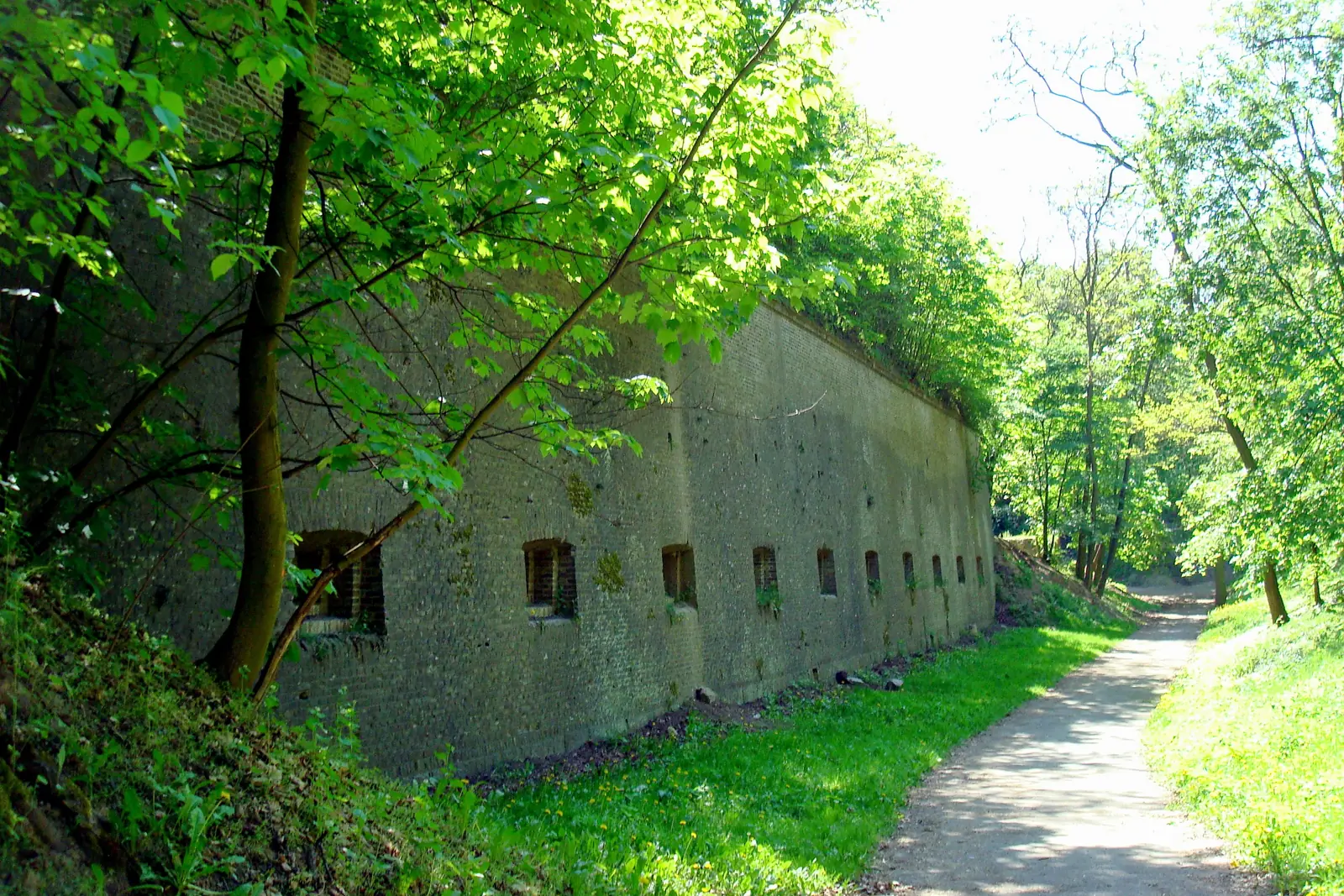
Few parks in Europe have a past as dramatic as Poznań’s. The green hill north of the Old Town was a village, then one of the largest fortresses of nineteenth-century Prussia, a Polish signals base, a prisoner-of-war camp and, in 1945, a battlefield. This page tells the story in order and shows where you can still see traces of it.
Timeline at a glance
| Year | Event |
|---|---|
| 1253 | Two villages called Winiary ("vineyards") recorded on the hill |
| 1828–1842 | Prussians build Fort Winiary, the core of the Poznań Fortress |
| 1846–1871 | Polish conspirators and foreign prisoners of war held in the fort |
| 29 Dec 1918 | Insurgents of the Greater Poland Uprising take over the Citadel |
| 1919–1939 | Polish signals units, a radio station and military railway |
| 1939–1945 | German occupation; the fort holds prisoners of war |
| 18–23 Feb 1945 | Red Army and Poznań volunteers storm the last German stronghold |
| 21 Jul 1946 | Arthur Greiser hanged on the slopes, Poland’s last public execution |
| 1950s–60s | Most of the fort demolished, its bricks reused |
| 1963–1970 | Park laid out over the ruins |
| 1992 | Renamed Park Cytadela |
| 2008 | Included in the Historic Monument "Poznań – historic city complex" |
Before the fortress: Winiary Hill
Poznań’s founding charter of 1253 already mentions two villages named Winiary on the hill; the name refers to vineyards, which survived on the slopes until the 1820s. By the late sixteenth century the land belonged to the city. When the Prussians chose the hill for their new fortress, the villages were moved north in 1830. Today’s Winiary district, beyond the park, is that relocated village.
Building Fort Winiary (1828–1842)
After the Congress of Vienna gave Poznań to Prussia, the army decided to turn the city into a fortress. The plan was drawn up by the engineer Johann Leopold Ludwig Brese, later ennobled as von Brese-Winiary, and construction was directed by Moritz von Prittwitz. Work began on 23 June 1828 by digging the moats.
The city describes it as the first fort built in the "New Prussian" polygonal system. Covering roughly 100 hectares, it had three bastions and four ravelins on the northern side, four detached redoubts on the south, and at its heart a three-storey barracks keep, the Kernwerk, finished in 1832. The outer line of defence ran for about 3 km, with a dry moat 6–32 m wide and around 7 m deep. The three bastions were later named Johann, Leopold and Ludwig after Brese’s own first names. The fort was linked to the rest of the fortress by two sluice-dams, the Great Sluice on the Warta and the Little Sluice on the Wierzbak stream.
The Citadel is often called the largest artillery fort of its day in Europe. That claim is repeated widely, but we have not found a source that compares it with other forts.
A prison and a garrison in the nineteenth century
For most of its first century the fort served as barracks and as a prison: Polish conspirators were held here after the foiled plot of 1846 and the risings of 1848 and 1863, and prisoners of war arrived after Prussia’s wars with Denmark (1864), Austria (1866) and France (1870–71). Some of them lie in the old cemeteries on the southern slope, described in our guide to the war cemeteries.
From 1876 a ring of outer forts was built around Poznań, which reduced the Citadel’s military importance. That wider system is covered on our page about the Poznań Fortress (in Polish). The Citadel saw no fighting in the First World War.
1918: the Greater Poland Uprising takes the Citadel
The Greater Poland Uprising broke out in Poznań on 27 December 1918. That day the Citadel’s radio station, already partly staffed by Poles under Sergeant Stanisław Jóźwiak, sent the first Polish radiogram about the situation in the city to the Armistice Commission in Spa. On 29 December an insurgent company marched in and the German garrison capitulated without a fight. Polish units were formed at the Citadel in the following months, and the captured radio station gave the insurgents direct contact with Warsaw and other European capitals.
Between the wars: signals, radio and codebreakers
In independent Poland the Citadel was a base for signals and supply units, above all the 7th Telegraph Battalion. A narrow-gauge military railway opened in 1923 to the training ground at Biedrusko, and from 1934 the transmitter of Polish Radio Poznań worked here.
The Second World War and the Battle of Poznań 1945
German troops entered Poznań on 10 September 1939. During the occupation the fort held prisoners of war: first Poles, including General Roman Abraham, and later British and Russian prisoners.
In January 1945 the Red Army surrounded the city, which the Germans had declared Festung Posen. The fortress garrison, probably around 15,000–20,000 strong, held out for weeks of street fighting, but by 12 February only the Citadel, then known as the Kernwerk, remained in German hands. The fortress had been commanded since late January by Ernst Gonell. The 29th Guards Rifle Corps of General Vasily Chuikov’s 8th Guards Army began the assault on 18 February. Soldiers crossed the moat on ladders under fire, and it took almost three days to silence the redoubts. Roughly 2,000 Poznań men were mobilised to help; around 100 of them were killed. They are remembered as the Cytadelowcy, and many lie in the Cemetery of Polish Heroes.
On 22 February Soviet tanks broke into the fort. Gonell shot himself and General Ernst Mattern surrendered the remaining garrison that night or on the morning of 23 February; sources differ on the hour. Casualty figures also vary widely between sources. Our Polish page on the assault on the Citadel in 1945 has the full account. The Red Army dead were buried around the new Heroes’ Monument, an obelisk unveiled in November 1945 (some sources say February 1946); see our Polish page on the Soviet soldiers’ cemetery.
After 1945: from ruins to a park
On 21 July 1946 Arthur Greiser, the Nazi governor of the Wartheland, was hanged on the Citadel’s slopes before a large crowd. It was the last public execution in Poland.
Most of the war-damaged fort was demolished in the 1950s and 1960s (sources differ on when most of the destruction happened), and its bricks went to rebuild Warsaw and Poznań. Bernard Lisiak drew up the design for a park over the ruins in 1961–1963, laying out radiating avenues that partly erased the old layout. It was built in 1963–1970, largely through voluntary community work, as the "Park-Monument of Brotherhood in Arms and Polish–Soviet Friendship". Sculptures, a summer amphitheatre (1968), a rose garden (1971) and, in 1986, the Bell of Peace (in Polish) followed. In 1992 the park was renamed Park Cytadela, and in 2017 its avenues lost their communist-era names.
The site was entered in the register of monuments in 1966, and since 2008 it has been part of the Historic Monument "Poznań – historic city complex". In 2026 work began to turn the derelict amphitheatre into a terraced garden of nectar-rich plants and to conserve the walls of Ravelin IV; the site is fenced off, and the city expects the work to last until the second quarter of 2027.
What survives today and where to see it
- Ravelin I, Redoubt I and Bastion II: brick walls and earthworks, best seen from the paths. Climbing the walls is forbidden.
- The North (Field) Gate on the northern side.
- The western casemate corridor: the vaulted passage that once led to the Little Sluice now houses the Poznań Army Museum.
- The artillery laboratory of the 1890s: home of the Museum of Armaments, whose exhibition covers the battle of 1945. See our museums guide.
- The cemeteries on the southern slope, including the Commonwealth graves described on our Great Escape graves page.
For a wider introduction to visiting today, return to the visitor guide, and see how to get there. Our Polish page on Fort Winiary goes deeper into the fortifications.
Frequently asked questions
When was Fort Winiary built?
Digging began on 23 June 1828 and the fort was completed in 1842. Its central barracks, the Kernwerk, was finished in 1832 and first garrisoned in 1834.
Who designed the Poznań Citadel?
The Prussian military engineer Johann Leopold Ludwig Brese, later ennobled as von Brese-Winiary. Construction was directed by Moritz von Prittwitz.
Was the Enigma code broken at the Poznań Citadel?
No. Cryptology courses for Poznań mathematics students were held in the signals barracks at the Citadel in 1929, but the Cipher Bureau’s Poznań outpost was in the city centre and Enigma was broken in Warsaw in 1932–33.
When did the Citadel fall in 1945?
The assault began on 18 February 1945 and the garrison capitulated on the night of 22 to 23 February. 23 February is commemorated as the end of the Battle of Poznań.
Is anything left of Fort Winiary?
Yes, but only fragments: Ravelin I, Redoubt I, Bastion II, the North (Field) Gate, the casemate corridor that houses the Poznań Army Museum and the artillery laboratory used by the Museum of Armaments.
What was Citadel Park called under communism?
It was built as the Park-Monument of Brotherhood in Arms and Polish–Soviet Friendship. It was renamed Park Cytadela in 1992.
Was Arthur Greiser executed at the Citadel?
Yes. The former Nazi governor of the Wartheland was hanged on the slopes of the Citadel on 21 July 1946, the last public execution in Poland.
Sources and verification
Facts on this page were checked against the sources below on 13 November 2026. Opening hours and prices can change — confirm with the venue before your visit.
- Poznań City Hall — Polygonal fortress: the Citadel (in English)
- Wikipedia (PL) — Fort Winiary
- Wikipedia (PL) — Twierdza Poznań
- Wikipedia — Battle of Poznań (1945)
- Adam Mickiewicz University, Faculty of Mathematics — Henryk Zygalski
- IPN Przystanek Historia — Arthur Greiser: zbrodnia i kara
- Wilkaniec, Chojnacka (2009), Nauka Przyroda Technologie — the Citadel park
- Journal of Laws 2008 no. 219 item 1401 — Historic Monument "Poznań – historic city complex"